Tooling resources are used to record and capture tooling costs when manufacturing an item. The Tooling resources list contains all currently configured tooling resources setup in the system.
Beneath the tooling grid there are 4 buttons:
Add: Add a new tooling resource.
Edit: Edit the selected tooling resource.
Copy: Copy the selected tooling resource.
Remove: Remove the selected tooling resource.
Note: The Remove button is disabled if the tooling resource is in use anywhere in the system.
Adding/Editing Tooling Resources
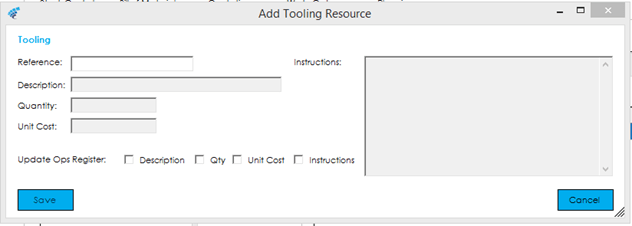
The ‘Add/Edit/Copy Tooling Resource’ screens are identical and contain the following information:
Reference: The tooling reference. This is the reference used when entering a tooling resource onto an operation on a BOM, Quote, or Works Order. This field must be unique.
Description: The tooling description.
Quantity: Determines the number of times the tooling resource can be used on an operation, before requiring replacement.
Unit Cost: This is the unit cost associated with the tooling quantity of an operation to determine the tooling cost based on the costed quantity of a Bill of Material, when costing a Bill of Material.
Instructions: The default tooling resource instructions.
Maintenance Schedule
You can record a recurring maintenance schedule against each tooling resource. Once a schedule is set, Cim50 will automatically generate a Servicing recommendation in the Planning module when the tool is due (or overdue) for service, so re-grinding, calibration, or replacement doesn’t get missed.
The Maintenance Schedule section contains the following fields:
Frequency: How often the tool is due for service. The available options are:
None – No maintenance schedule is in place for this tool. The Value and Last Serviced fields are disabled.
Hours – the tool is due for service after a set number of run-time hours have been booked against the machine resources it is used on. Cim50 measures usage by adding up the booked time since the tool was last serviced.
Days, Weeks, Months, or Years – the tool is due for service a set period of time after it was last serviced.
Value: The number of hours, days, weeks, months, or years between services.
LastServiced: The date and time the tool was last serviced. For an Hours-based frequency this is the point Cim50 starts counting run-time from. For time-based frequencies it is the date the next service interval is measured from.
Note: If you set Frequency to anything other than ‘None’ but leave Last Serviced blank, the recommendation cannot be calculated. Cim50 will record a configuration warning explaining what is missing – these can be reviewed via the Planning Servicing view (see below).
How service-due notifications work
When MRP is run, Cim50 checks every machine and tooling resource that has a maintenance schedule. If a resource is due, or overdue, a Servicing recommendation is added to the Planning module. These appear in the Planning panel by changing the view drop-down to ‘Servicing’.
From the Servicing view you can highlight a recommendation and use the Action button to confirm the service has been carried out – this stamps the tool with a new Last Serviced date and time and the next interval starts running from that point.
Press Save to save the new or amended resource to the database.